Friday, August 25, 2006

Mark Seifrid: Tolerance in Justification

In Mark Seifrid’s [1] article, “Luther, Melanchton and Paul on the Question of Imputation” [2], he wishes for more tolerance in the divergent opinions in relationship to justification, in particular those who would like to broaden it to include the transformative aspect of God’s divine grace. He argues for this by discussing Luther and Melanchton historical dispute in regards to justification.

Seifrid describes Melanchton view of justification in the period between 1530 and 1534 as somewhat confusing by which he is able to describe justification as a “being made righteous” (transformative) as well as a “being pronounced righteous” (declarative), but later his view appears to change to a “purely forensic terms over against his earlier writings” [3]

Seifrid describes Luther view of justification as both forensic and transformative, by which “the mercy of God effects a “perfect righteousness “which “swallows up wrath, sin, and death”, thus producing a new reality.” [4] This is not to say that Luther believed that justification is grounded by “good works”, but that justification is “no mere declaration, but rather an effective word of God” [5], creating a new creation.

It appears Seifrid attributes Melanchton’s turn from justification being partial “transformative” to strictly “forensic” and his difficulties in understanding Luther’s “transformative” view of justification are due to the radically different perspectives by which they started from. "Melanchton takes the human being as his starting-point, and thinks of justification in terms of human qualities and response. It is surely for this reason that he has such great difficulty to understanding Luther, who views justification first and foremost in terms of the Gospel, the word of God, which, apart from any contribution from the fallen human being, brings the new creature into existence, in whom faith and all its work are present.” [6]

Seifird writes that even though Luther and Melanchton differ in their view of justification, they were tolerant of each other. He writes: “Surely the outcome of their debate is instructive for us. Although they maintained their differences, Luther and Melanchton accepted one another’s teaching on justification…Don’t the Reformers, therefore, set a precedent for us to follow? Isn’t it sufficient to agree that God’s justifying work in Christ is a forensic act, by which in the Word and faith we are granted an alien, extrinsic righteousness, which is final and unconditioned? On this point, I would very much like to woo all parties to the various disputes on justification.” [7]

[1] New Testament Professor at Southern Seminary

[2] Article found in the book, “What’s at Stake in the Current Debates Justification” pg. 137-152

[3] pg. 142

[4] pg. 141

[5] pg. 145

[6] pg. 143

[7] pg. 150

Wednesday, August 23, 2006

FPC and The Pearland Overture

One of my elders(Elder Wei) at my church gave this speak below to the members of the New Covenant presbytery, during which the Pearland Overture (which basically guards against homosexual ordination in my presbytery) was passed. I am glad to see my little Taiwanese Church take a stance on this important issue. Good job guys!!!

"Mr. Moderator,

My name is Y.T. Wei.

I am an Elder member of this presbytery. I come from Formosan Presbyterian Church. Our Session concurred with the overture from Pearland Presbyterian Church.

So I am speaking in favor of it. We want New Covenant to declare its intention as a presbytery to maintain the ordination requirements of the Book of Order as essentials of our polity.

Most Presbyterian leaders in the Taiwanese community, like our Session at Formosan PC here in Houston, do not understand why the PCUSA seems to be constantly arguing over the possibility of ordaining people who do not see any need to repent of disobeying the 7th commandment.

We believe the Bible clearly teaches that homosexual practice and all other forms of adultery are wrong. It is important for our Christian witness in the Taiwanese community that we belong to a church that takes fidelity in marriage and chastity in singleness to be basic and essential standards of Christian morality.

We would prefer not to have to enter into this debate. But the PUP report recommendation #5 which passed at General Assembly makes it necessary for us to speak up. Without giving us a chance to vote on it at the presbytery level, this PUP report seems to have opened up the possibility that the ordination standards we have always counted on as the Biblical witness of the PCUSA are no longer firmly reliable.

Please don't put us in such an awkward position within our community. We believe this overture will help Taiwanese Presbyterian Churches to maintain a faithful Biblical witness and therefore to remain in the PCUSA.

Please vote "Yes" for this overture.

Thank you and God bless you."

Monday, August 21, 2006

Within The Bounds of Orthodoxy

"Within The Bounds of Orthodoxy: An Examination of Both the Federal Vision and the New Perspectives on Paul" by Joseph Minich is probably one of the better treatment of the Federal Vision and the New Perspective I have read. Mr. Minich helpfully goes over the major controversial surrounding both the FV and NPP. I was particularly fascinated in Mr. Minch helpful treatment of N.T. Wright, as he sought to understand Wright on his own terms rather than through "Reformed" categories. I highly recommend reading this article before making any strong judgments in regards to both the FV and NPP, especially for the sake of unity within the church. I also whole heartily concur with Mr. Minich's view of dealing with controversy, especially in the age of technological advances, as he writes :

" The selective reading has been particularly devastating. It is so easy these days to accuse another person of heresy and to have this charge spread nationwide. But should we not take the charge of gospel slander with much more gravity? Should not love believe and hope all things concerning a brother in Christ? Indeed, it seems to me that we should never accuse of heresy unless we have sweated blood in a ferocious attempt to prove that our brothers were not heretics. Until we have spent all our effort trying to read them as charitably as possible, we have no right to speak against them."

Friday, August 11, 2006

John Frame on "Leaving the Church/Denomination"

In Ch. 17 of Frame's book "Evangelical Reunion", he gives us a framework in thinking about leaving a denomination/church. Frame deals briefly with issues such as the sin of creating a new denomination, living up to ordination vows, denomination and property (a hot issue in the PCUSA) and he finally concludes that there is "no circumstances in which one would be forbidden to leave a church or a denomination".

For those in PCUSA, you might want to check this out.

Wednesday, August 09, 2006

FAKE Interview with John Piper and N.T. Wright Part 2

Interviewer to Piper: To my understanding, you do not believe that Romans 2 is a "hypothetical" statement, so what does works have to do with the last judgment?

Piper: "In the last day there will be a judgment. It will settle finally and publicly who enters eternal life and who doesn't. The verdict, "not guilty," at this judgment will be based on the work of Christ on the cross. The guilt of all true believers was carried by Jesus: "the Lord has laid on him the iniquity of us all" (Isaiah 53:6). But that verdict will "accord with our deeds" - our daily lives will give evidence that we trusted Christ more than money and that we loved him more than the praise of men. [1]

Interviewer to Wright: If works are the necessary evidences for Christian in the final judgment, where can we find our assurance for salvation?

Wright: As God's true people, they are therefore assured of eternal life. Chapters 5-8 are one long argument for assurance, based on the new covenant blessings of forgiveness and the Spirit. The same Spirit who inspired justifying faith is at work in believers to do 'what the law could not do' (8:3)—to complete, in other words, the renewal of the covenant. He will give life in place of death (8: 1-11), holiness in place of sin (8: 12-13), sonship in place of slavery (8:14-17), the new creation in place of the old, and therefore hope in the midst of sufferings (8:18-27).Chapter 8 thus rounds off the train of thought that began in 2:1-16, and proves that the present verdict of 'righteous' will indeed be reaffirmed on the last day. Christians are those who 'by patience in well-doing seek for glory and honour and immortality' (they seek for it, even now they do not earn it, those to whom God 'will give eternal life'. [3]

Interviewer to both: If someone is struggling with their salvation, what would you say to them?

Wright: [It would depend on the situation, but one of the things I would say is that], "the doctrine of justification by faith is that all this is even now certain for those who believe in the Gospel; the experience of justification by faith is the steadfast looking away from oneself at the objective facts of incarnation and atonement, revealing as they do the unchanging and unshakeable love of God for his people. This is justification: because of the work of the Son and the Spirit, God pronounces in the present the future verdict of 'righteous' over all who believe. Irrespective of moral or racial background, believers are declared to belong for all eternity to the true people of Abraham, the family of the renewed covenant, the people whose sins are forgiven. [3]

Piper: [Firstly], we should look to Christ and the glory of his finished work on the cross for sinners… Justification and eternal life are not earned by our deeds. They are freely given to those who look to Christ in faith. So if we are going to obtain the glory of God and be glorified we must trust Christ. [5]. Secondly, we should continually pray for God to "enlighten the eyes of our hearts" (Ephesians 1:18). Thirdly, we should love each other; because, as John said, "We know that we have passed out of death into life, because we love the brethren." In the end, assurance is a precious gift of God. Let us pray for each other that it will abound among us. [6]

Interviewer to Wright: Why are you against the idea of imputation of Christ's righteousness?

Wright: "There are only two passages which can be invoked in favour of the imputed righteousness being that of God or Christ. The first proves too much, and the second not enough. The first is 1 Corinthians 1.30f., where Paul says that Christ has become for us wisdom from God, and righteousness, sanctification and redemption. Wisdom is the main point he is making, and the other three nouns come in as a way of saying ‘and everything else as well’. ‘Yea, all I need, in thee to find, O Lamb of God, I come’; that line sums it up well. I doubt if this will sustain the normal ‘imputation’ theology, because it would seem to demand equal air time for the imputation of wisdom, sanctification and redemption as well. The second passage is 2 Corinthians 5.21, which as I have argued elsewhere is not, as a matter of good exegesis, a statement of soteriology but of apostolic vocation. The entire passage is about the way in which Paul’s new covenant ministry, through the death and resurrection of Jesus, is in fact God’s appointed means for establishing and maintaining the church. ‘So that we might become God’s righteousness in him’ means that in Christ those who are called to be apostolic preachers actually embody God’s own covenant faithfulness. I do not expect to convince you by this microcomsic summary of the point, but I submit that it deserves careful exegetical consideration, not dismissing with a wave of the hand and a reference to Brother Martin"[4]

Interviewer to Wright: If there's no imputation of Christ's righteous doesn't that open the door for "merit theology/semi-Pelagianism" in relationship to justification?"

Wright: [Again],”that might be so if I intended to denote, with the word ‘justification’, what the tradition has denoted. But I don’t. Paul, I believe, uses vindication/justification to denote God’s declaration about someone, about (more specifically) the person who has been ‘called’.... Vindication is not the same as call.[4]" 'Justification' itself is not God's act of changing the heart or character of the person; that is what Paul means by the 'call', which comes through the word and the Spirit [2]. This is where it is vital to distinguish justification from regeneration. Justification is not how God makes someone a Christian: it is his righteous declaration that someone is already a Christian. [3]

Interviewer to Wright: Are you saying that your view of justification isn't "semi-Pelagianism" because justification is the "declaration about someone" and not "the call” or the processing of making someone a Christian, which comes only through God's gracious act?

Interviewer to Piper: Do you buy this explanation?

Piper: ?????????????? (How will Piper respond??)


[1] John Piper, "No Partiality with God" Part 2

[2] N.T. Wright, “The Shape of Justification”

[3] N.T. Wright, “Justification; “The Biblical Basis and Its Relevance for Contemporary Evangelicalism”

[4] N.T. Wright,’” New Perspectives on Paul”

[5] John Piper, “The Final Divide: Eternal Life or Eternal Wrath Part 3”

[6] John Piper, “The Agonizing Problem of Assurance of Salvation”

Tuesday, August 08, 2006

Watchout Britney!!

FPC Grad. Banquet

FAKE Interview with John Piper and N.T. Wright Part 1

Here's a FAKE interview with John Piper and N.T. Wright on justification. I am doing this so that people can get a better understanding of Wright's view on justification in comparison to the traditional view of justification (represented by my hero, John Piper).

It's important to note that I am no expert on Wright or Piper, but I think I know them both well enough to make this at least educational. Also, I tried to use direct quotes from both Piper and Wright in their responses to my fake questions. Please also note that anything that's in a bracket, I have added to their responses in order to make the interview more real.


Interviewer to Wright: Do you believe that justification is forensic and declarative?

Wright: [Yes], “It is God’s declaration that a person is in the right; that is, (a) that their sins have been forgiven, and (b) that they are part of the single covenant family promised to Abraham. Notice that opening phrase: God’s declaration that. Not ‘God’s bringing it about that’, but God’s authoritative declaration of what is in fact the case. This is the point, of course, where some have accused me of semi-Pelagianism. That might be so if I intended to denote, with the word ‘justification’, what the tradition has denoted. But I don’t. Paul, I believe, uses vindication/justification to denote God’s declaration about someone, about (more specifically) the person who has been ‘called’... Vindication is not the same as call. [4]"

Interviewer to Wright: "Forgiveness of sins?", so you don't believe that justification deals with just ecclesiology and not soteriology?

Wright: "This present declaration constitutes all believers as the single people, the one family, promised to Abraham (Gal. 2.14 - 3.29; Rom. 3.27 - 4.17), the people whose sins have been dealt with as part of the fulfilled promise of covenant renewal (Jer. 31.31-34). Membership in this family cannot be played off against forgiveness of sins: the two belong together." [2]

Interviewer to both: What is the ground or the basis for this justification?

Piper: "the righteousness of God, expressed in the alien, imputed, active obedience of Christ, climaxing in his sin-bearing, substitutionary death is the sole ground of our justification, and faith is distinct from its fruit, the obedience of faith, yet faith is of such a nature that it must and will produce love for people and a life of genuine, though imperfect holiness in this world. Therefore, as the Westminster Confession of Faith (11.2) says, the faith that alone justifies (as the instrument which unites us to Christ, not as the ground or content of our justifying righteousness) is never alone; Therefore, this reality of forensic righteousness, which is imputed to us on the first act of saving faith (as the seed of subsequent persevering faith), is different from transformative sanctification, which is imparted by the work of the Holy Spirit through faith in future grace.*

Wright: [First], “this vindication occurs twice. It occurs in the future, as we have seen, on the basis of the entire life a person has led in the power of the Spirit – that is, it occurs on the basis of ‘works’ in Paul’s redefined sense. And, near the heart of Paul’s theology, it occurs in the present as an anticipation of that future verdict, when someone, responding in believing obedience to the ‘call’ of the gospel, believes that Jesus is Lord and that God raised him from the dead" [4]

Interviewer to Wright: Sorry, what I meant with "grounds" or "basis" for justification, I was trying to refer to the idea of whom or what "accomplishes" or "merits" justification.

Wright: [I wouldn't use the word "merit"] ,but "justification is made possible by grace incarnate: sins are dealt with on the cross, the blood of the new covenant is poured out. In biblical terms, the way to deal with sin is to punish it: in Gethsemane, and on the cross itself, Jesus obeys his Father's saving purposes by drinking the cup of the wrath of God, so that his people may not drink it. Justification and atonement are not the same thing: justification presupposes an objective dealing with sin. There can be no present justification if atonement is merely a process within the sinner, or merely a readiness on God's part not to take sin seriously after all. Justification safeguards, because it presupposes the centrality of the cross and resurrection. [3]

Wright: Likewise, secondly, justification presupposes the work of the Spirit, promised in the Old Testament as the one who would write God's law on the hearts of his new covenant people. Justification takes place on the basis of faith because true Christian faith— belief that Jesus is Lord and that God raised him from the dead —is the evidence of the work of the Spirit, and hence the evidence that the believer is already within the covenant. If a man believes this Gospel, his religious stance is clear. He can be neither Jew nor Greek, but only Christian. This is where it is vital to distinguish justification from regeneration. Justification is not how God makes someone a Christian: it is his righteous declaration that someone is already a Christian. Faith is not an achievement which earns salvation, but the evidence of saving grace already at work. Only the renewed heart can believe in the resurrection: only the penitent heart can submit to Jesus as Savior and Lord. Because of the work of the Son and the Spirit, God rightly declares that Christian believers are members of the covenant family. The basis of justification is the grace of God freely given to undeserving sinners.

Interviewer to Wright: Thanks for clarifying. So justification is "based" on Christ and the Holy Spirit, and it's entirely gracious? But what do you mean when you say that future justification is based" on the entire life of a person, which has been led in the power of the Spirit"? Does mean that we are somehow meriting, earning, or providing the legal grounds for justification?

Wright: "The ‘works’ in accordance with which the Christian will be vindicated on the last day are not the unaided works of the self-help moralist. Nor are they the performance of the ethnically distinctive Jewish boundary-markers (sabbath, food-laws and circumcision). They are the things which show, rather, that one is in Christ; the things which are produced in one’s life as a result of the Spirit’s indwelling and operation [4]"

Interviewer: So the works in final justification are evidences that you are a Christian and not meritorious.


Sunday, August 06, 2006

Piper and Wright on “Future Grace”

One of the greatest truths I have learned from Piper is that saving faith is one that looks to and rest on God’s promises in Christ for salvation, both in the past, present and future.

Piper writes:

“A second assumption is that justifying faith is not only a trusting in the past grace of God, but also a trusting in the future grace of God, secured by the past grace of Christ’s death and resurrection. Justifying faith embraces the finished work of Christ’s atonement, in sense that it rests in all that this atonement means for our past, present and future.” [1]

Also to my amazement, Wright articulates something similar to Piper:

“Romans 8 thus points to the crowning glory of Paul's doctrine of justification. It demonstrates that the assurance which is contained in the doctrine is found not in looking at anything in oneself, not even at one's faith, but in faith itself, which is looking to Christ” [2]

“The doctrine of justification by faith is that all this is even now certain for those who believe in the Gospel; the experience of justification by faith is the steadfast looking away from oneself at the objective facts of incarnation and atonement, revealing as they do the unchanging and unshakeable love of God for his people. This is justification: because of the work of the Son and the Spirit, God pronounces in the present the future verdict of 'righteous' over all who believe. Irrespective of moral or racial background, believers are declared to belong for all eternity to the true people of Abraham, the family of the renewed covenant, the people whose sins are forgiven.” [2]

“The 'faith' in question is faith in 'the God who raised Jesus from the dead'. It comes about through the announcement of God's word, the gospel, which works powerfully in the hearts of hearers, 'calling' them to believe, or indeed (as Paul often puts it) to 'obey' the gospel (Rom. 1.16f.; 1 Thess. 1.3f., 2.13; 2 Thess. 1.8). This faith looks backwards to what God has done in Christ, by means of his own obedient faithfulness to God's purpose (Rom. 5.19; Phil. 2.6), relying on that rather than on anything that is true of oneself. For Paul, this meant refusing to regard the badges of Jewish law-observance ('the works of the law') as the decisive factor (Phil. 3.2-11). And it looks forward to the final day: because this faith is the first sign of new God-given life, it is the appropriate anticipation of the final verdict, which is guaranteed by the same Spirit who inspired faith (2 Cor. 1.22; Phil. 1.6).” [3]

[1] John Piper, “Future Grace”, pg. 27

[2] N.T. Wright, “Justification: The Biblical Basis and its Relevance for Contemporary Evangelicalism”

[3] N.T. Wright, “The Shape of Justification”

Friday, August 04, 2006

Piper and Wright

In Piper's lastest "Fresh Word", he has written some tough comments about Wright's view of justification.

He writes:

"The other book is a response to N. T. Wright on the doctrine of justification. I have no immediate plan to publish it until I get the feedback from critical readers. My motivation in writing it is that I think his understanding of Paul is wrong and his view of justification is harmful to the church and to the human soul. Few things are more precious than the truth of justification by faith alone because of Christ alone. As a shepherd of a flock of God’s blood-bought church, I feel responsible to lead the sheep to life-giving pastures. That is not what the sheep find in Wright’s view of Paul on justification. He is an eloquent and influential writer and is, I believe, misleading many people on the doctrine of justification. I will keep you posted on what becomes of this manuscript." [1]

[HT] Justin Taylor's blog

[1] http://www.desiringgod.org/library/fresh_words/2006/080206.html

Thursday, August 03, 2006

"The Doer of the Law Who Will be Justified": Romans 2:13

13For it is not the hearers of the law who are righteous before God, but the doers of the law who will be justified. - Romans 2:13


Hypothetical Statement?

In the Reformed tradition, verse 13 has been described as a "hypothetical statement", stating that people can be justified by doing the law or having good works if they could only obey the law perfectly, but since no one can, the only option is to be justified by faith.

Evidence of Being in Christ

Rather than verse 13 being a "hypothetical statement", I believe this verse is describing a true Christian, who by the transforming power of the Holy Spirit will be a "doer of the law" or someone who will produce good works. It's important to note that I am not saying that works will merit or earn justification, but it will be the evidences of our union with Christ.

Piper and Wright Quotes:


John Piper states:

"I think that when Paul says, "doers of the law will be justified," he means that there really are such people, and they are the only people who will be acquitted at the judgment. This is not a hypothetical statement. It is a statement of actual, experienced fact. When Christ comes into a person's life by the power of the Holy Spirit through faith in the Gospel, that person becomes a "doer of the law." Not a sinlessly perfect law-keeper, but one who loves the law of God (= the law of Christ), and depends on God's help to live according to the truth (which now includes the cross of Christ and the work of the Spirit), and trusts God for his mercy when he stumbles (according to 1 John 1:9)." [1]

"Romans 2:13b says, "Doers of the Law will be justified." It does not say, "By doing works of the Law you will be justified." It simply says that the ones who will be justified are also those who are doers of the law. There is no causal connection asserted. So the verse is not a contradiction of Romans 3:20 which says, "By the works of the Law no flesh will be justified." There is nothing in Romans 2:13b that keeps us from believing in justification by faith alone. Faith is required by the Law, and faith is the sole means of union with Christ whose righteousness vindicates us at the judgment. All the other obedience that comes from faith is the fruit of that union, not the means of it. So Romans 2:13b is not a contradiction of Paul's teaching of justification by faith alone." [1]

[1] From Piper's sermon entitled "No Partiality with God" Part 2. See
http://www.desiringgod.org/library/sermons/99/013199.html


N.T. Wright states:

"This passage has often been read differently. We heard yesterday that Augustine had problems with it (perhaps the only thing in common between Augustine and E. P. Sanders). That is hardly surprising; here is the first statement about justification in Romans, and lo and behold it affirms justification according to works! The doers of the law, he says, will be justified (2.13). Shock, horror; Paul cannot (so many have thought) have really meant it. So the passage has been treated as a hypothetical position which Paul then undermines by showing that nobody can actually achieve it; or, by Sanders for instance, as a piece of unassimilated Jewish preaching which Paul allows to stand even though it conflicts with other things he says. But all such theories are undermined by exegesis itself, not least by observing the many small but significant threads that stitch Romans 2 into the fabric of the letter as a whole. Paul means what he says. Granted, he redefines what ‘doing the law’ really means; he does this in chapter 8, and again in chapter 10, with a codicil in chapter 13. But he makes the point most compactly in Philippians 1.6: he who began a good work in you will bring it to completion on the day of Christ Jesus. The ‘works’ in accordance with which the Christian will be vindicated on the last day are not the unaided works of the self-help moralist. Nor are they the performance of the ethnically distinctive Jewish boundary-markers (sabbath, food-laws and circumcision). They are the things which show, rather, that one is in Christ; the things which are produced in one’s life as a result of the Spirit’s indwelling and operation. In this way, Romans 8.1–17 provides the real answer to Romans 2.1–16. Why is there now ‘no condemnation’? Because, on the one hand, God has condemned sin in the flesh of Christ (let no-one say, as some have done, that this theme is absent in my work; it was and remains central in my thinking and my spirituality); and, on the other hand, because the Spirit is at work to do, within believers, what the Law could not do – ultimately, to give life, but a life that begins in the present with the putting to death of the deeds of the body and the obedient submission to the leading of the Spirit."[2]

[2] From Wright's talk entitled "New Perspectives on Paul". See http://www.ntwrightpage.com/Wright_New_Perspectives.htm

Wednesday, August 02, 2006

Gospel Presentation: Two Ways to Live

Probably the best gospel tract I have ever seen. Check it out by clicking the link below:

http://www.matthiasmedia.com.au/2wtl/index.asp

Monday, July 31, 2006

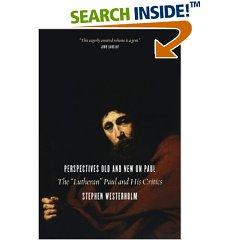
Book Recommendation: “Perspectives Old and New on Paul


Stephen Westerholm’s “Perspectives Old and New on Paul: The “Lutheran” Paul and His Critics” is probably the best book to get acquainted not only with the New Perspectives on Paul (NPP), but to also brush up on the Old Perspective on Paul or the “Lutheran” position (Westerholm defines “Lutheran” as the basic traditional/reformed positions). The book is divided into two major selections, with the first part being a survey of some of the important “players” in Pauline theology, such as the historic “Lutheran” scholars (Augustine, Luther, Calvin and Wesley), the modern “Lutheran” scholars (Cranfield, Schreiner, Thielman), and some proponents of the NPP (Sanders, Dunn, and Wright). This selection alone is worth the price of the book, as I can’t think of any other resource that gives such a broad overview of all the “key” scholars in the debate.

The second selection, Westerholm gives a reasonable and strong exegetical defense for his “Lutheran/traditional/reformed” position by examining key words and phases in the debate such as examining Paul usage of “righteousness” (dikaiosness) and “law”, and by analyzing Paul’s thoughts on “justification by faith” in each of his epistles. If anyone wishes to seriously engage in the Pauline debate and I would highly recommend this book.

Friday, July 28, 2006

Christian Social and Political Engagement

Check out this discussion with Tony Campolo and Russell Moore on the Al Mohler Radio Show.

Campolo thinks Christians should broaden the social issue to more than the abortion issue, and Moore thinks the abortion issue is the ultimate issue. Interesting stuff.

http://www.albertmohler.com/radio_show.php?cdate=2006-07-21

Sunday, July 23, 2006

Congratulations Ariane and Tony!! :)

The wedding party....

Kunal, Brad, and Dan

Tony's amazingly cute son, JOSH!! :)
Dan in rare form, on the dance floor.

Julia and Kunal, getting rough.....

Thursday, July 20, 2006

New Paul Perspective Part 1


The New Paul Perspective (NPP) is a theological framework which suggest for a new understanding of Pauline theology in which 2nd Temple Judaism is viewed primarily as a religion of "grace" rather than one of "legalism". Therefore, Paul's critique of the Pharisees was not primarily one of legalism (trying to earn salvation by works), but one due to nationalistic boasting which required Gentiles to convert to Judaism (proselyte) in order to be identified as God's people.

The three most prominent NPP proponents are E.P. Sanders, James Dunn, and N.T. Wright. I personally have not studied first-hand any of Sander's and Dunn's works (even though I have read critiques of their works), but I have read quite a few of Wright's articles and books, including "The New Testament and the People of God" and "The Climax of the Covenant".

With that being said, I will try to examine the New Paul Perspective with a focus on Wright's work by addressing the following questions:

1. What are the NPP proponents trying to emphasize and say?
2. What are the major criticisms of the NPP, especially Wright, and are they valid?
3. How should the church respond to the NPP, namely Wright?

Tuesday, July 11, 2006

BETTER MICHAEL JORDANS IN "HEAVEN"????

Here's a quick summary of a great article entitled "Heaven:Not Just an Eternal Day Off" by the late Anthony Hoekema, who taught at Calvin Theological Seminary.

Is heaven boring?*

"Life in heaven sounds downright boring, if some descriptions are to be believed. In my boyhood, psalms were sung very slowly in church, and I thought heaven was like that—a place where one sat on hard benches all day long and sang Dutch Psalms. I was not enthralled. Huck Finn thought heaven was a place where a person would "go around all day long with a harp and sing, forever and forever." This future life is often seen as an eternal existence without bodies. Also, it is thought of as "above," somewhere off in space, far removed from this earth—an escape, in fact."

Heaven is a tempory existence*

"Are we then to spend eternity in space, disembodied spirits who flit from cloud to cloud, plucking golden harps in an endless day off? We can agree with the element of truth in these teachings: Paul tells us that when he dies he will go to be with Christ (Phil. 1:23), who has now been taken up into heaven (Acts 1:11). And he also says that this state is "away from the body and at home with the Lord" (2 Cor. 5:8). But, and here is the critical point, this will be a temporary existence—one where we shall eagerly await the resurrection of the body to take place on the last day, at Jesus' second coming.

Ressurection is forever*

"Resurrected bodies are not intended just to float in space, or to flit from cloud to cloud. They call for a new earth on which to live and to work, glorifying God. The doctrine of the resurrection of the body, in fact, makes no sense whatever apart from the doctrine of the new earth."

Renewed and Purified, not Annihilated*

"Hoekema quoting Edward Thurneysen writes, "The world into which we shall enter in the Parousia (2nd coming) of Jesus Christ is therefore not another world; it is this world, this heaven, this earth; both, however, passed away and renewed. It is these forests, these fields, these cities, these streets, these people, that will be the scene of redemption. At present they are battlefields, full of the strife and sorrow of the not-yet-accomplished consummation; then they will be fields of victory, fields of harvest, where out of seed that was sown with tears the everlasting sheaves will be reaped and brought home" (Zwischen den Zeiten, 1931, p. 209)."

Restoration, not the Destruction of "WORK" in the New Heaven and Earth*

"In the resurrection we shall retain our individuality, but in a heightened way. This means that we shall not only still possess the gifts God gave us, but that our potential for exercising these gifts will then be realized to the full—as it never was in this life. Using the analogy between the talents of a child and the fully developed gifts of an adult, Abraham Kuyper suggests that in the life to come we will retain the seeds of our present gifts, but God will then give to what is developed from those seeds a new form that will be in harmony with the everlasting glory of his kingdom (Gemeene Gracie, I, 461)."

"In the beginning man was given the so-called cultural mandate—the command to rule over the earth and to develop a God-glorifying culture. Because of man's fall into sin, that cultural mandate has never been carried out in the way God intended. Only on the new earth will it be perfectly and sinlessly fulfilled. Only then shall we be able to rule the earth properly."

Better Rembrants, Better Raphaels, Better MICHAEL JORDANS???*

"The possibilities that now rise before us boggle the mind. Will there be "better Beethoven" on the new earth, as one author has suggested? Shall we then see better Rembrandts, better Raphaels, better Constables? Shall we read better poetry, better drama, and better prose?"

"Will scientists continue to advance in technological achievement, will geologists continue to dig out the treasures of the earth, and will architects continue to build imposing and attractive structures? Will there be exciting new adventures in space travel? Shall we perhaps be able to explore new Perelandras? We do not know. But we do know that human dominion over nature will then be perfect. Our culture will glorify God in ways that surpass our most fantastic dreams."

Developing and Building the Kingdom, NOW*

This all means a lot for us now. If there is continuity as well as discontinuity between this earth and the new earth, we must work hard to develop our gifts and talents, and to come as close as we can to producing, in the strength of the Spirit, a Christian culture today. Through our kingdom service, the building materials for the new earth are now being gathered. Bibles are being translated, peoples are being evangelized, believers are being renewed, and cultures are being transformed. Only eternity will reveal the full significance of what has been done for Christ here on earth.

*These summary points are mine, and do not appear in the original article.

The full article can be found here:
http://www.christianitytoday.com/ct/2003/122/54.0.html

Saturday, July 08, 2006

Paul's Desire: "Resurrection From the Dead"

For his sake I have suffered the loss of all things and count them as rubbish, in order that I may gain Christ 9and be found in him, not having a righteousness of my own that comes from the law, but that which comes through faith in Christ, the righteousness from God that depends on faith-- 10that I may know him and the power of his resurrection, and may share his sufferings, becoming like him in his death, 11that by any means possible I may attain the resurrection from the dead. 12Not that I have already obtained this or am already perfect, but I press on to make it my own, because Christ Jesus has made me his own. 13Brothers, I do not consider that I have made it my own. But one thing I do: forgetting what lies behind and straining forward to what lies ahead, 14I press on toward the goal for the prize of the upward call of God in Christ Jesus. 15Let those of us who are mature think this way, and if in anything you think otherwise, God will reveal that also to you. 16Only let us hold true to what we have attained. - Phil. 3:8-16

Paul’s Desires

Knowing and embracing Christ is everything for Paul, so much so, that everything is considered "rubbish" compared to his relationship with him (Phil 3:8). Even though Paul is presently united with Christ, he understands that this relationship is not at its consummated and final state. So what is the futuristic (eschatological) state that Paul longs for? Is it being with Christ in a spiritual heavenly realm (Phil.1:21)? Or is it something else?

Paul's ultimate goal isn't just to be with Christ in the present or in heaven when he dies, but "for the prize of the upward call of God in Christ Jesus" (v.14), that is, to "attain the resurrection from the dead, which will happen when Christ comes back to fully establish his kingdom on a physical new earth and heaven (1 Corinthians 15).


Even though Paul knows that Christ will come back, he doesn't sit back and just “chill”, but he strives and presses forward to obtain “the prize of the upward call of God in Christ Jesus” (Phil 3:12-14). Just like Paul, we should also strive to obtain the "resurrection from the dead", so that we can fully enjoy Christ's presence. But how should we strive to obtain this prize?


How Should We Strive To Obtain the Prize?

First, we should know that God in his sovereign love in Christ is the one who provides the ultimate power in our striving and promises to one day complete it.

6And I am sure of this, that he who began a good work in you will bring it to completion at the day of Jesus Christ (Phil 1:6)

12Therefore, my beloved, as you have always obeyed, so now, not only as in my presence but much more in my absence, work out your own salvation with fear and trembling, 13for it is God who works in you, both to will and to work for his good pleasure. (Phil 2:12-13)

20But our citizenship is in heaven, and from it we await a Savior, the Lord Jesus Christ, 21who will transform our lowly body to be like his glorious body, by the power that enables him even to subject all things to himself (Phil 3:20)

Second, we should strive for in humility and love for others

3Do nothing from rivalry or conceit, but in humility count others more significant than yourselves. 4Let each of you look not only to his own interests, but also to the interests of others (Phil 2:3)

Third, we should hold fast to God's word

16holding fast to the word of life, so that in the day of Christ I may be proud that I did not run in vain or labor in vain. (Phil.2:16)

Fourth, we should be partners for the gospel, the message that Jesus Christ is Lord and Savior of the universe

3I thank my God in all my remembrance of you, 4always in every prayer of mine for you all making my prayer with joy, 5because of your partnership in the gospel from the first day until now. 6And I am sure of this, that he who began a good work in you will bring it to completion at the day of Jesus Christ (Phil 1:3-6)

2I entreat Euodia and I entreat Syntyche to agree in the Lord. 3Yes, I ask you also, true companion, help these women, who have labored side by side with me in the gospel together with Clement and the rest of my fellow workers, whose names are in the book of life. (Phil 5:2-3)

Fifth, we should pray, especially when anxious

6do not be anxious about anything, but in everything by prayer and supplication with thanksgiving let your requests be made known to God. 7And the peace of God, which surpasses all understanding, will guard your hearts and your minds in Christ Jesus. (Phil 4:6-7)

Wednesday, June 21, 2006

PCUSA and Recommendation #5

Yesterday, the PCUSA voted 298-221 (57% to 43%) to approval the PUP (Peace, Unity, and Purity) Report, which includes the controversial "recommendation #5", which basically allows individual governing body (presbyteries) to interpret and determine the ordination standards. For an example, a presbytery can decide that an unrepentant homosexual is "ok" to be a pastor and that this determination doesn't go against the "essential tenets of the Reformed faith", therefore making it more easier* to ordain an unrepentant homosexual person.

Despite voting in the PUP report, the PCUSA also voted that the "fidelity-chastity" ordination requirement be left in the Book of Order, which clearly defines that a ordained person must practice fidelity in marriage (between a man and woman) or "chastity" in being single.

So on the same day, the PCUSA voted in a rule (recommendation #5) that would allow some presbyteries to make it more easier to ordain unrepentant homosexuals, they also reaffirmed a requirement more or less created to prevent unrepentant homosexuals from becoming pastors.

In the end, I am not sure if we have made any progress. I believe until the PCUSA takes a definite stance on the issue of homosexual ordination, we will continue to have these "ordination wars" and we will never truly have "peace", "unity" and "purity".


*According to one blogger ( http://reformed-angler.blogspot.com/2006/06/pup-voting-underway.html), the process and results of the governing body can still be reviewed by a higher authority, therefore at least in theory it doesn't seem like the individual governing body can do whatever they want.

For more information check out:http://www.layman.org/